Over the last couple of years, “attention” has become a key metric and a hot topic in the marketing industry, and for good reason. The term itself is not new, but its interpretation, and its role alongside other marketing metrics, has been redefined. Attention is now a quality score, mainly for digital media channels, that gives more perspective on the real value of impressions across channels.
An attention score is built from a combination of ad exposure data, such as eye tracking, viewability, engagement and ad position. As a quality score, attention adds an interesting new layer on top of simpler metrics like impressions and clicks.
At Alviss, we would like to add our perspective to the attention debate and bring a fresh (but actually old-school) approach to the table. Sometimes it makes sense to take a step back and think about the purpose of it all. Any marketing investment, in any channel, essentially has one basic purpose: to be seen and remembered by the audience it targets.
So why not measure your media effectiveness against the ad awareness you already have in your brand tracker? Ad awareness is a solid measure, typically delivered weekly by a high-quality panel, with several years of back data to learn from. What’s not to like?
How do you then say something about the attention (ad awareness) delivered by your marketing channels? You build a simple econometric model with media spend as input and ad awareness as the KPI. The principles are the same as in marketing mix modelling (MMM), just with fewer data points. It is not a new methodology, but we believe the market should remind itself of it in the attention debate, because it is still very valuable and fairly easy to carry out.
A few upsides of this approach to “attention measurement”
- It captures the effect across all channels, offline and online, in a neutral way.
- It uses back data going back several years, so it can draw conclusions about past campaigns and investments.
- It captures not only upper-funnel effects on ad awareness, but also potential effects on lower-funnel brand KPIs.
- It needs only two data sources, brand tracking and media investments, both at weekly level.
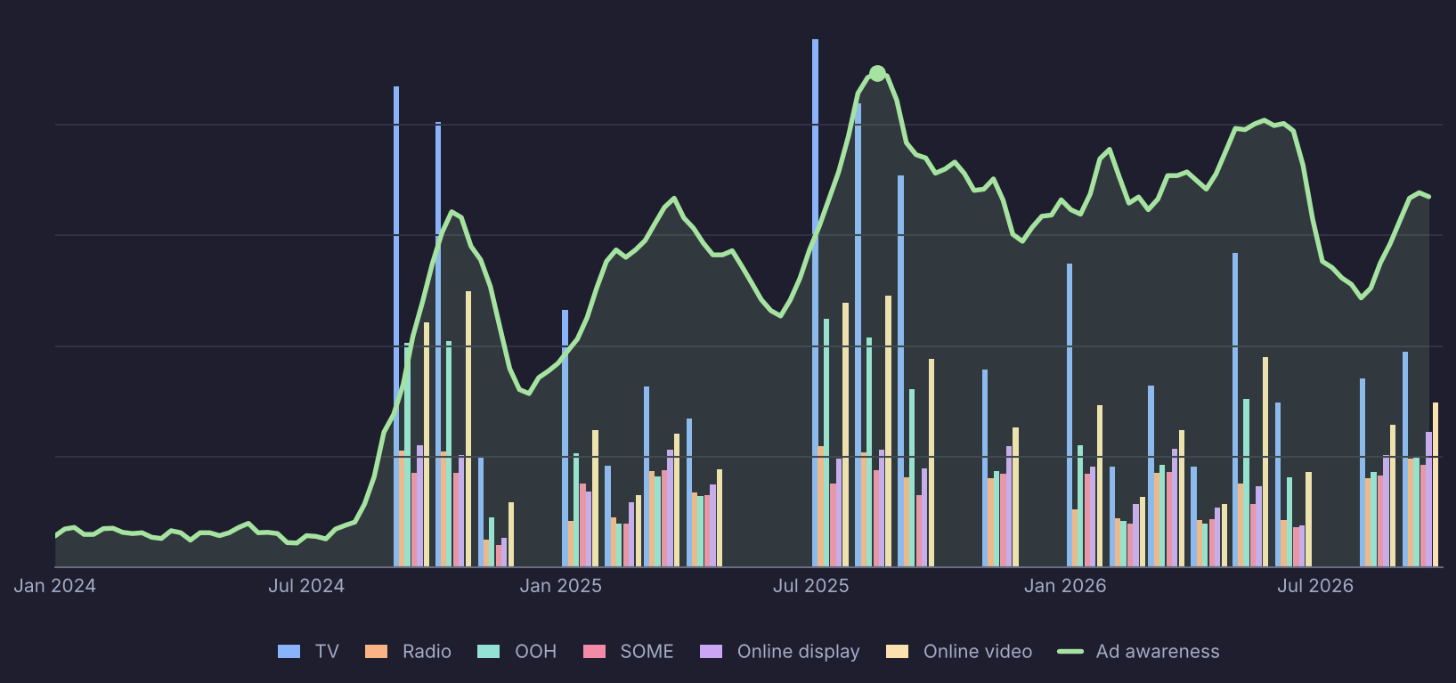
- It is simple and transparent: media investments explain the uplifts in historic ad awareness.
What does it look like?
The graph below shows an illustrative example of ad awareness over roughly two years, together with media spend across six channels. This is essentially the input data you need to build a solid model of media effectiveness on ad awareness, or put differently, of the channels’ real ability to deliver attention.
Conclusion
Attention is a hot topic in the marketing industry, and many advertisers and media specialists are focused on it. If you see ad awareness as a higher-level expression of attention, you can get far with a modelled approach like the one described in this blog post. It can give you valuable insights for your marketing strategy, such as:
- The overall effect of marketing investments on ad awareness (or other brand KPIs)
- Effectiveness and efficiency by media channel
- Carry-over effects and adstock by channel
So you can measure attention from your media spend in a modelled setup, with ad awareness as the KPI. No need to complicate it more than necessary.